Talk to Your Doctor
Talk to Your Doctor
Talk to your doctor about a fracture risk assessment

Talk to your healthcare provider about a comprehensive fracture risk assessment to understand your likelihood of another fracture and to plan ways to protect your bone health.
The assessment may include:
A Bone Mineral Density (BMD) test
A review of secondary causes of bone loss (such as certain medications or health conditions)
Discussion about any conditions like celiac disease, rheumatoid arthritis, or thyroid disorders
A review of medications that may affect bone strength (e.g., long-term glucocorticoids, aromatase inhibitors, androgen deprivation therapy, etc.)
Evaluation of falls risk and mobility
There may also be other assessments, depending on your situation, for example, reviewing vitamin D levels, kidney function, or hormone balance. Your healthcare provider can use these results to help decide whether you would benefit from medication, lifestyle changes, or both.
FRAX (Fracture Risk Assessment)
To use the tool, click the image below which will redirect you to the calculation tool.
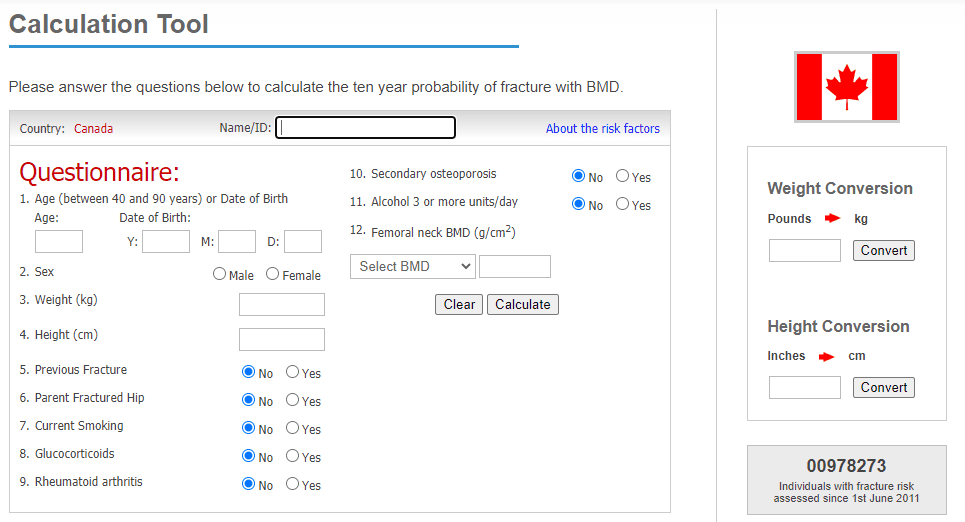
The FRAX® tool estimates your 10-year probability of a hip fracture or a major osteoporotic fracture (hip, spine, forearm, or shoulder).
FRAX takes into account several factors, including:
Age, Sex assigned at birth, Bone Mineral Density (BMD) at the femoral neck, Prior fracture history, Steroid use, Smoking and alcohol intake, Other clinical risk factorsFRAX is widely used in Canada as part of fracture risk assessment but is
- 2023 guideline update note:
FRAX is still an endorsed tool but should not be used alone to make treatment decisions. It should be combined with BMD and clinical context.
CAROC (Canadian Association of Radiologists and Osteoporosis Canada)
The CAROC tool, developed by Osteoporosis Canada and the Canadian Association of Radiologists, estimates your 10-year absolute risk of fracture based on BMD and key risk factors.
In addition to femoral neck (hip) BMD, age, sex, fracture history and steroid use are taken into consideration to determine an individual’s 10-year risk of fracture.
A patient with a fragility fracture and using steroids is at high fracture risk even without the BMD result.
To see the charts that are part of the CAROC tool, click here.
Lifestyle Changes
Talk to your healthcare provider about lifestyle and daily habits that support bone health and reduce your risk of another fracture.
You might also be referred to other professionals such as a dietitian, physiotherapist, or pharmacist to support your care plan.